
ACH vs. Wire Transfer vs. Stablecoin Settlement: Which Rail Fits Your Payment?
Businesses moving money choose between ACH, wire transfers, and stablecoin settlement. Each rail has distinct trade-offs in speed, cost, availability, and geographic reach. Here's how they compare and when to use each.
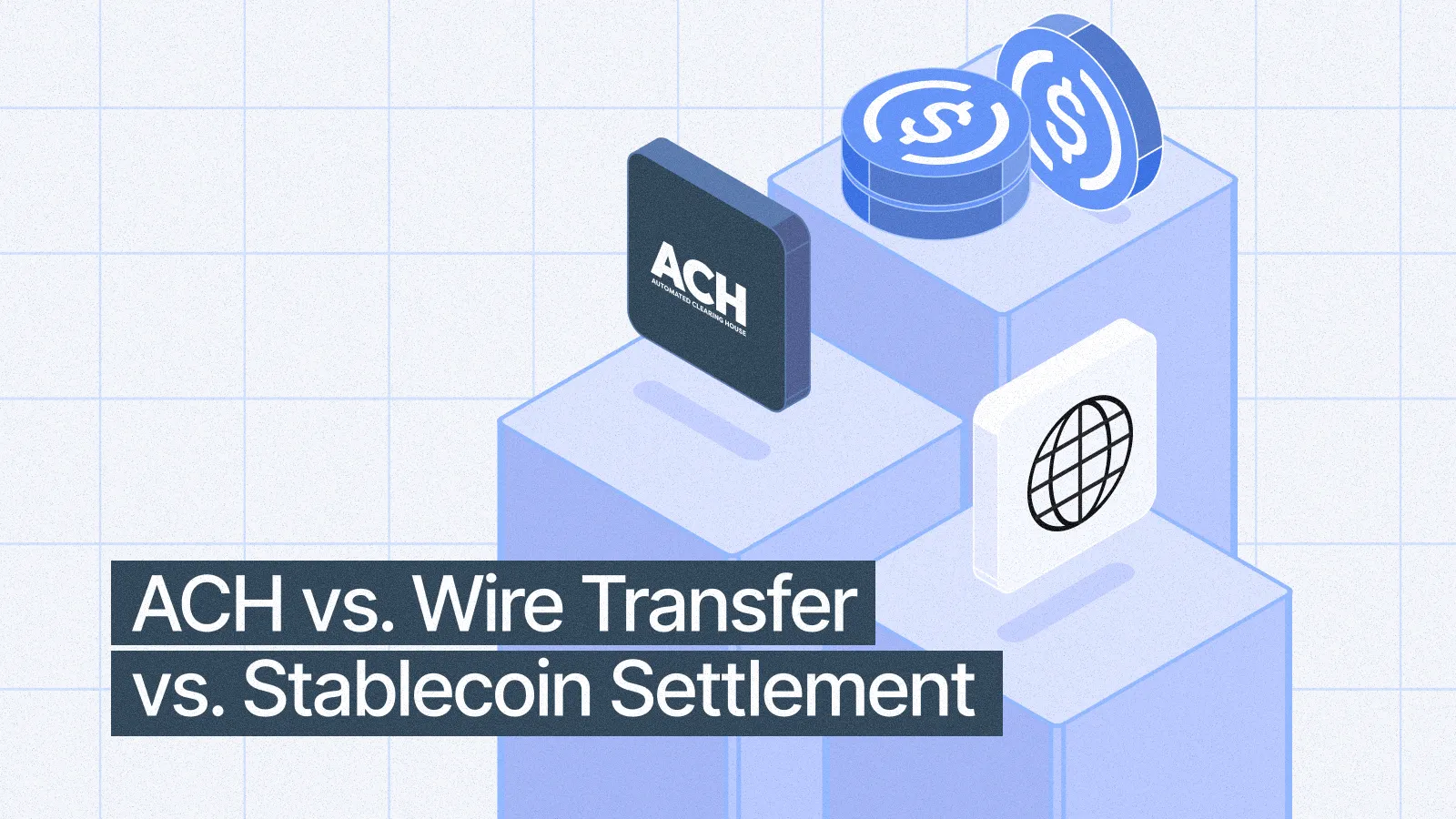
Businesses moving money domestically or internationally choose between three primary settlement methods: ACH for low-cost batch payments, wire transfers for high-value time-sensitive transfers, and stablecoin settlement for fast cross-border payments that settle around the clock. Each rail has distinct trade-offs in speed, cost, availability, and geographic reach.
ACH: The Low-Cost Domestic Workhorse
The Automated Clearing House, operated by Nacha, is the backbone of domestic US payments. In 2024, the ACH network processed 33.6 billion payments representing $86.2 trillion in value. ACH is the standard choice for businesses sending recurring payments because the cost is measured in cents per transaction, settlement is reliable, and the infrastructure is mature.
ACH transfers typically settle within 1 to 2 business days, though same-day ACH is now available for eligible transactions. Because ACH operates on a batch basis and only during US business hours, transfers initiated on weekends or after 5pm will not process until the next business day. ACH is also reversible: unauthorized transactions can be disputed for up to 60 days, which provides protection to both senders and receivers.
ACH works best for payroll distribution, recurring vendor payments, subscription billing, and other recurring domestic transfers where the cost savings outweigh the slower settlement timeline.
Wire Transfer: Fast but Expensive
Wire transfers are the opposite of ACH in almost every way: they are fast, expensive, and final.
Domestic wire transfers are processed through Fedwire and settle same-day in real time, as long as the transfer is initiated during Fedwire operating hours (roughly 9am to 6pm Eastern). Domestic wire fees typically range from $25 to $50 per transfer, plus any fees charged by the receiving bank.
International wire transfers are significantly more complex. They move through a network of correspondent banks and typically use the SWIFT messaging standard. An international wire may pass through 3 to 5 intermediary banks, each of which may charge a fee (typically $15 to $50 per bank). The entire transfer process can take 1 to 5 business days, and the receiving bank may apply an FX markup if the currencies do not match. By the time the beneficiary receives the funds, the total cost can easily exceed $100 plus FX losses.
Critically, wire transfers are generally final once settled. Unlike ACH, there is no 60-day window to dispute or reverse a wire transfer. This finality is appropriate for high-value transfers but adds execution risk: a typo in the bank account or routing number cannot be undone.
Wires are best used for large-value transfers, time-sensitive payments, and situations where the speed justifies the cost.
Stablecoin Settlement: The Cross-Border Alternative
Stablecoin settlement operates on blockchain networks and offers a fundamentally different model: on-chain transfers settle in minutes, operate 24 hours a day, 7 days a week, 365 days a year, and are not limited by banking hours, correspondent banking networks, or geographic boundaries.
When a business transfers USD-pegged stablecoins such as USDC or USDT across a blockchain, the transaction settles within minutes. Network fees (called gas fees) are typically lower than wire fees, especially on Ethereum and other high-throughput chains. There is no FX conversion risk because the stablecoin is already denominated in a single currency.
The catch is that stablecoin transfers require on-ramp and off-ramp infrastructure: the sender must convert fiat currency to stablecoins, and the receiver must convert stablecoins back to fiat currency. This adds two additional steps, each of which may include fees and regulatory requirements. Regulated stablecoin providers layer on compliance controls such as KYC (Know Your Customer), sanctions screening, and Travel Rule implementation to ensure the transfer meets regulatory standards.
Stablecoin settlement is most valuable for cross-border payments, high-frequency corridors, and use cases where 24/7 availability is critical.
Side-by-Side Comparison
Speed
- ACH: 1 to 2 business days (same-day available)
- Wire: Same-day domestic; 1 to 5 business days international
- Stablecoin: Minutes
Cost
- ACH: Cents per transaction ($0.20 to $1.00)
- Wire: $25 to $50 per transaction domestically; $50 to $150+ internationally with correspondent fees and FX markup
- Stablecoin: Network fees (usually $1 to $20) plus on/off-ramp fees (varies by provider)
Availability
- ACH: US business hours and business days only
- Wire: Fedwire hours (9am to 6pm ET) for domestic; standard banking hours for international
- Stablecoin: 24/7/365
Geographic Reach
- ACH: US domestic only
- Wire: Worldwide via SWIFT and correspondent banking
- Stablecoin: Worldwide on supported blockchains; not limited by banking infrastructure
Reversibility
- ACH: Reversible within 60 days
- Wire: Final and not reversible
- Stablecoin: Immutable on blockchain; reversals possible only via separate transaction
Best Use Case
- ACH: Payroll, recurring payments, vendor billing, low-cost domestic transfers
- Wire: High-value transfers, time-sensitive domestic payments, international transfers
- Stablecoin: Cross-border payments, speed-sensitive corridors, 24/7 availability requirements, thin banking corridors
Choosing the Right Rail
Most businesses use all three in complementary ways. ACH handles the bulk of domestic recurring payments, wires cover high-value and international transfers, and stablecoins are emerging as a tool for speed-sensitive cross-border corridors where traditional banking infrastructure is slow or expensive.
The choice depends on the specific use case. Are you paying employees in the same country monthly? Use ACH. Do you need to move $500,000 across a border by end of business today? Consider a wire. Are you operating in a thin corridor where wire infrastructure is expensive or slow? Stablecoin settlement may be faster and cheaper.
The rails are complementary. A forward-looking treasury operation understands the trade-offs of each and selects the right rail based on the payment profile: domestic vs. international, recurring vs. one-time, cost-sensitive vs. speed-sensitive, and high-value vs. low-value.
The Bottom Line
ACH, wire transfers, and stablecoin settlement represent three distinct approaches to moving money, each with specific strengths. ACH wins on cost and reversibility but is slow and US-only. Wire transfers offer speed and international reach but come with high fees and finality risk. Stablecoin settlement offers speed and 24/7 availability but requires on and off-ramp infrastructure and regulatory integration.
As corporate payment systems become more sophisticated, the combination of all three rails will likely become standard. Businesses that understand the trade-offs and match each payment type to the right rail will optimize for both cost and speed.
What Is Customer Due Diligence (CDD)? KYC Explained
Customer Due Diligence is the process of identifying customers, verifying their identity, and establishing beneficial ownership. Here's how the CDD Rule works and what it means for stablecoin and fintech companies.

What Is an FBO Account? Customer Funds in Custody
FBO accounts let fintech platforms hold customer funds at FDIC-insured banks without a banking license. Here's how they work, what happened when Synapse collapsed, and what the new rules mean.