
Blocking the Map Isn’t Enough: What the Nvidia Chip Saga Teaches About Circumvention Risk
Sphere's Chief Compliance Officer on what the Megaspeed case reveals about export-control circumvention.
A Clean Address, a Messy Trail
Most coverage of Nvidia this month has focused on a personal scandal and an alleged intelligence operation. For those of us who build compliance programs, the more instructive story is a Singapore data center company called Megaspeed.
As reported by the New York Times and others, Megaspeed was incorporated in Singapore under a Chinese parent, changed hands twice in 2023, and became an Nvidia Cloud Partner four days after its last sale. It went on to import more than $4 billion in Nvidia hardware, and US authorities have been examining since 2024 whether it helped Chinese companies get around export controls. Trade records reportedly show its Malaysian subsidiary kept receiving roughly $800 million in controlled technology for eight months after Nvidia put it on a no-sell list, mostly through third-party server makers. Nvidia has said the US Commerce Department allowed it to ship some repair parts after the block, and it still lists Megaspeed as a cloud partner.
As of this writing, none of this has been proven. The Justice Department is leading a criminal investigation, Singapore is investigating Megaspeed and six individuals, and Malaysia is checking whether chips brought in by Megaspeed's subsidiary were re-exported. On November 23, Commerce added Megaspeed and six linked companies to the Entity List. Megaspeed says it takes its export-control obligations seriously and has cooperated with US inspections. Still, the pattern is one every sanctions and export-control professional will recognize: a counterparty in a “safe” jurisdiction, a respectable commercial profile, and a supply chain that kept moving after the red flags appeared. Treasury Secretary Scott Bessent framed the real question well: did Nvidia know its customer, and was it guarding against sales to pass-through shell companies?
Two Routes Around a Control
There are two ways to get past a trade restriction: change the rules, or route around them. The Nvidia saga shows both, and only one of them is a compliance problem.
The first route runs through policy. Lobbying, licensing and diplomacy can loosen a restriction. A licensed sale is a policy outcome, and screening programs are built to respect it.
The second route is the one compliance teams live with every day. Most countries and companies cut off from a market have no seat at the policy table, so they reach for the oldest tools available: front companies, transshipment hubs, layered intermediaries and inaccurate end-use declarations. Restrictions redirect demand into channels designed to look legitimate.
Three Circumvention Channels
The alleged Megaspeed pattern combines three circumvention channels, each of which leaves a different trace in financial flows. Analysts at Epoch AI estimate that smuggled chips equal to about 1.6 million H100s reached China through 2025, mostly via Southeast Asia, so the problem sits in the channel itself, well beyond any single company.
- Redomiciling. Chinese-origin firms incorporating in Singapore have become common enough to earn a nickname, “Singapore washing.” The jurisdiction on the KYB file is clean; the ownership history and the customer base tell a different story.
- Intermediaries. Singapore investigated possible false declarations in server purchases, and Malaysia is examining whether chips were re-exported without permits. When a direct supplier stops selling, the product keeps arriving through resellers and system integrators.
- Remote access. The newest channel requires no shipment at all. Chips stay in a third-country data center and China-based customers rent the compute power, which is exactly what the Commerce Department's Bureau of Industry and Security (BIS) moved to restrict on November 16.
For a payments company, the third channel matters most. An export-control problem that used to appear as a shipment now appears as a recurring service payment, a financing draw or a cross-border subscription fee. FinCEN and BIS have repeatedly published joint red flags for export-control evasion, and financial institutions are expected to apply them to the money, not just the goods.
Why Blocking the Map Falls Behind
A jurisdiction-only model would have rated this activity low risk. Singapore and Malaysia are not sanctioned, not on any FATF list, and well regarded as trading hubs, yet they sat at the center of the alleged diversion network.
Then the risk picture changed in a week. BIS’s November 16 rule, effective November 19, now requires licenses for advanced chips shipped to Singapore, Malaysia, Thailand, Indonesia and Brazil because of a higher-than-normal risk of diversion. Five jurisdictions were re-rated by an export-control agency, outside any list cycle that anyone in AML compliance tracks.
Even the US government's own list lagged. Commerce opened its investigation in 2024, Nvidia stopped selling to Megaspeed in June 2025, and four agencies reportedly pushed for a listing for months. The designation came on November 23, 2026.
This is my concern with programs that wait on FATF plenaries to decide what they can and cannot do. FATF lists measure AML/CFT deficiencies; they were never designed to capture export-control diversion, and they update a few times a year. Blocking prohibited jurisdictions is necessary, but it is the floor of a sanctions program, not the program.
Trusted Trade Channels
The opposite error is just as costly. Blanket blocking of anything that touches a higher-risk jurisdiction cuts off legitimate trade, pushes it into less transparent channels, and teaches the business to route around compliance. Some activity that looks high risk on a map is, on inspection, lower risk because it moves through what we've started calling a trusted trade channel, or TTC.
But Megaspeed is also a warning about how we define trust. On paper it looked like a TTC: a Singapore entity, an official Nvidia partner, a household-name customer and bank financing. An established trade route between a higher-risk and a lower-risk jurisdiction can be the evasion channel itself. Trust has to attach to verified participants and controls.
In practice, a channel earns TTC treatment when it shows:
- Verified ownership and control, traced to natural persons and re-verified on every change of control.
- Activity that matches footprint, such as purchases consistent with installed capacity. A BIS visit in 2024 reportedly found equipment still boxed in Megaspeed’s Malaysian facility.
- Regulatory standing, such as licenses, Validated End-User status or a clean post-shipment verification.
- Aligned flows, where payer, beneficiary, ship-to and end user tell one consistent story.
- An observed track record, built from our own data rather than the counterparty’s assertions.
Trust must also be revocable. A change of control, credible adverse media, a regulator inquiry or a rule like November 16’s should downgrade a TTC immediately. And the downgrade must reach the intermediaries around a counterparty, because a no-sell list that resellers can route around is not a control.
A Framework That Models Channels
The approach we take at Sphere, and the idea behind an internal tool we call the Sanctions Globe, is to score trade lanes in three layers rather than countries in one.

- Jurisdiction baseline: sanctions programs, export-control country groups, FATF status and other country-level indicators.
- Channel overlay: known circumvention corridors raise the risk of a specific lane, even when both endpoints rate low.
- Counterparty overlay: verified TTC participants lower the risk of activity on a lane, even when one endpoint rates high.
The illustrative lanes below show how the same framework can move a rating in either direction.
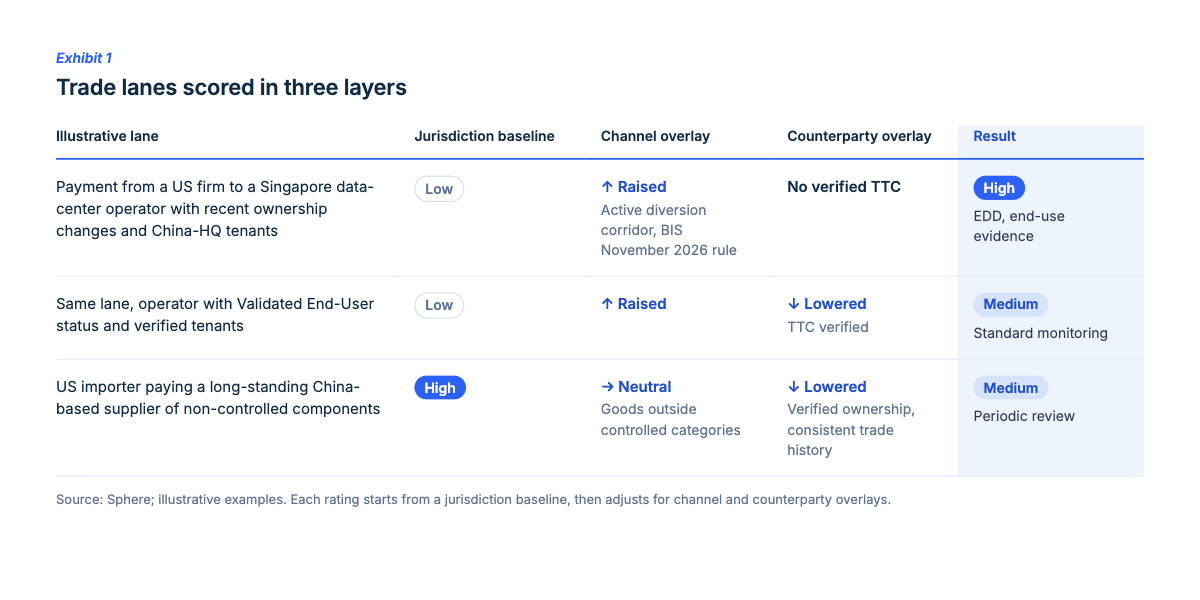
The model also updates when events happen, such as a new rule, an enforcement action or credible adverse media, rather than when the next list is published.
What This Means for Payments Compliance
Payment companies rarely see the boxes, but we always see the money, and payment data is often the earliest signal that a channel has turned. A sudden lease payment to a newly reorganized data-center operator, financing that outruns installed capacity, or a mismatch between payer and end user can surface diversion before any customs record does.
Nvidia's board has drawn its own lesson. It recently formed a National Security and Export Control Committee of independent directors to oversee trade compliance. When a chipmaker of that scale moves export control to board-level oversight, every company in the chain, including the ones moving the money, should take note.
My recommendation is simple: block what is prohibited, model what is being circumvented, and recognize what is genuinely trusted. A program built that way moves faster than any list.
About the author

Scott F. Butler
CCO
Scott F. Butler is the Chief Compliance Officer at Sphere, where he sits at the nexus of several timely issues: the future of stablecoin regulation, cross-border payments, and the use of AI in regulated compliance programs.
Scott has a background in banking compliance (Deutsche Bank, Credit Suisse) but has since specialized in building regulated payments entities within unconventional industries. He developed the compliance framework for Fiant, a video game payments company that became the first startup to secure and maintain the New York BitLicense. At Tilia (later acquired by Thunes), he devised and operated the compliance program for Second Life, the world's first metaverse economy. Before that, he designed Meta's first regulated payments compliance program for Facebook Payments, Inc.

Subscribe to Sphere Blog
No spam. Just the latest releases and tips, interesting articles, and exclusive interviews in your inbox every week.

The Making of a Commodity Market for Compute
Capital and futures have reached compute before a standard unit of trade or clearing. What that means for lenders, investors and the market.

DB Securities Partners with Sphere Labs to Explore Commercial Opportunities Through Security Token Offering (STO) Pilots
Under the MOU signed on November 10, 2026, the companies will explore potential commercial applications in Korea and abroad.